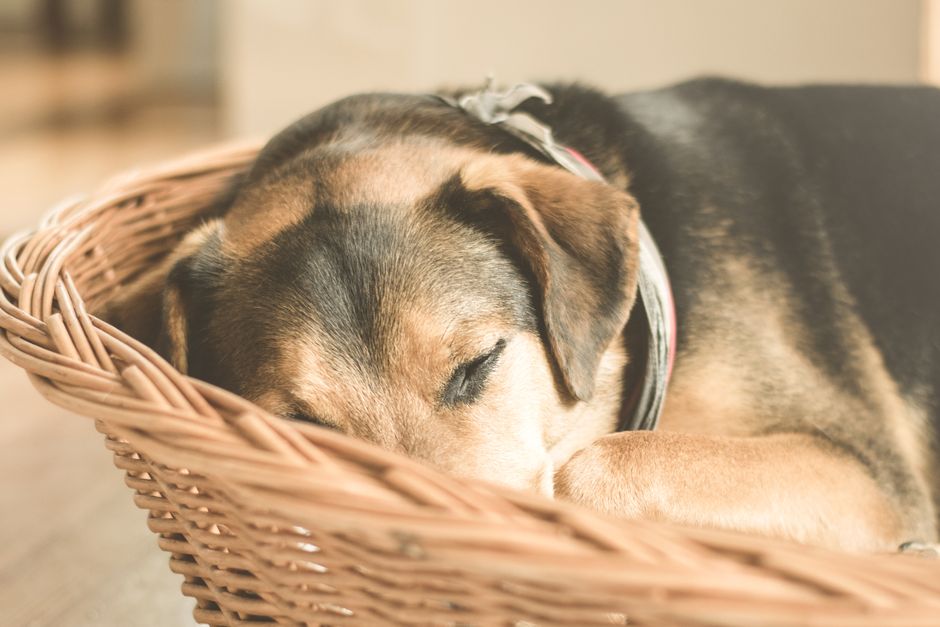
A calming dog bed will not cure anxiety, but the right donut or bolster bed gives a nervous dog a safe, den-like place to settle. This guide explains why these beds help, how to choose one, and which fits the way your dog worries.
Updated June 2026·18 min read·Researched against canine behavior and comfort guidance
What does your dog's anxiety actually look like?
There is no single best calming bed, only the right one for the way your dog worries. Tell us the signs and we will point you to the bed that fits, not a top-five list.
What a calming dog bed for anxiety can and cannot do
Before you spend anything, it helps to be honest about what a bed is. A calming bed is a piece of comfort equipment, not a treatment. The raised rim, the deep fill, and the soft faux fur give a nervous dog a den-like place to feel surrounded and safe, and for a lot of dogs that genuinely takes the edge off restlessness and trouble settling. What it will not do is rewire a dog's brain. Keep your expectations in the right place and the bed becomes a useful tool instead of a disappointment, and the rest of this guide is built around that honest middle ground: real help for everyday nerves, and a clear pointer to your vet when the problem is bigger than a bed can reach.
Myth
A calming bed cures anxiety.
Truth
It does not. It is comfort support. It can help a mildly anxious dog settle and give a fixed safe spot, but real anxiety disorders, true separation panic, and noise phobia need behavior work and sometimes your vet. The bed is one part of the plan, not the plan.
Myth
Any soft bed counts as a calming bed.
Truth
No. The calming effect comes from edges. A flat plush pad with no rim gives a worried dog nothing to press into. A real calming bed surrounds the dog with a bolster or donut wall it can lean and rest its chin on.
Myth
The biggest, fluffiest bed is the best.
Truth
Often the opposite. A bed too large for the dog loses the snug, surrounded feeling that does the work. A frightened dog wants to feel held, not lost in an open field of fluff. Fit matters more than size.
Myth
If it does not work the first night, it failed.
Truth
Give it time. A new bed is one more strange object to a nervous dog. With a familiar scent, a fixed location, and a few low-pressure introductions, most dogs adopt the bed over days, not minutes.
With that settled, the useful question is not which bed is best overall. It is which bed suits the particular way your dog gets anxious, and why a bed with the right shape works at all. So we will start with what is actually happening when a worried dog digs, circles, and wedges itself into a corner.
Why anxious dogs burrow, nest, and press into walls
To understand why a particular bed settles a nervous dog, it helps to understand what an anxious dog is actually trying to do when it scratches at the carpet, wedges behind the sofa, or drags a blanket into a corner. None of these are random. They are old, hardwired comfort behaviors, and a good calming bed works precisely because it gives those instincts somewhere to land instead of fighting them.
Dogs are the descendants of denning animals. Wild canids dig or claim sheltered burrows to raise pups, sleep, and ride out bad weather, and domestic dogs carry the same preference for a small, enclosed, defensible space. A den is somewhere a dog can tuck its body against solid sides, keep an eye on the entrance, and stop scanning for threats from every direction at once. An open floor, or a flat pad in the middle of a room, offers none of that. A bed with a continuous raised wall recreates the basic geometry of a den, which is why a frightened dog will so often choose the bed with edges over the larger, softer pad beside it.
The circling, digging, and pawing most dogs do before they lie down is another inheritance. Ancestral dogs trampled grass and leaves into a nest to flatten it, adjust its temperature, and check for anything unwelcome hiding underneath. The ritual survives in dogs that have never seen tall grass, which is why your dog scratches at a bed it cannot possibly rearrange. A plush, deep surface lets a dog perform that ritual and feel it has worked, fluffing and shaping a spot before settling. A thin, hard pad frustrates the instinct, and a frustrated, under-settled dog stays a little more switched on than it needs to be.
Curling into a tight ball is the most efficient way for a dog to conserve heat, protect its vulnerable belly, and feel compact and contained. Stress and warmth-seeking often travel together, and a worried or unwell dog frequently looks for somewhere warm to burrow. Long-furred and deep-filled beds trap warmth and let a dog disappear into them, which is genuinely soothing for a heat-seeker, though it can be too much bed in a hot room or for a thick-coated breed that overheats easily.
Gentle, even pressure around the body has a calming, grounding effect on many animals, the same principle behind swaddling an infant or the snug fit of an anxiety wrap. A bolster or a deep donut rim presses lightly and evenly against a dog that leans into it, giving steady, reassuring feedback that it is held and contained. This is not a cure and it does not work for every dog, but for a large number of nervous dogs that constant, low-level contact is the difference between perching tensely on the edge and melting into real sleep.
Two social instincts finish the picture. Puppies sleep in a heap, piled against warm siblings, and many adult dogs never lose the comfort of resting against another body. A padded rim stands in for that littermate, something solid and soft to lean a spine against or drape a chin over. And a dog that can put its back to a wall and face the room is a dog that can finally stop guarding its blind side. The surrounded, backed-up position lowers the need for constant vigilance, and a dog that is not on guard is a dog that can rest. Put those five instincts together and you have the entire case for a calming bed: it is not magic, it is a piece of furniture shaped to match behaviors your dog already has.
There is also a feedback loop worth knowing about. Anxiety disrupts sleep, and poor sleep makes a dog more reactive and less able to cope the next day, which feeds still more anxiety. Dogs need far more rest than many owners realize, and broken, vigilant, low-quality sleep leaves a nervous dog permanently on edge. A bed that helps a dog drop into deeper, longer sleep is not only a comfort, it breaks one link in that loop, which is part of why a settled sleeping spot can have an outsized effect on a dog's daytime mood and behavior.
One last word of caution, about the word calming itself. It is a marketing term, not a regulated claim, and any bed at all can carry it. Nothing about the label guarantees the rim is deep enough, the fill is generous enough, or the shape is enclosing enough to actually do the job. That is why the rest of this guide keeps coming back to features you can see and feel rather than the name on the box, and why two beds both sold as calming can perform completely differently for the same dog. Judge the bed, not the adjective.
The den instinct
Dogs descend from animals that sheltered in burrows. An enclosed space with solid sides reads as safe and defensible, so a worried dog seeks walls, not open floor.
The nesting ritual
Circling, digging, and pawing before lying down is inherited nest-building. A deep, plush surface lets the dog perform and complete the ritual instead of fighting it.
Warmth and curling
Curling tight conserves heat and shields the belly. Stress and warmth-seeking go together, so deep, furred beds that a dog can burrow into are calming for heat-seekers.
Pressure that reassures
Light, even pressure soothes many animals, the logic behind swaddling and anxiety wraps. A rim a dog leans into gives steady feedback that it is held.
The littermate memory
Puppies sleep piled against siblings. A padded bolster stands in for that warm body, giving an adult dog something soft and solid to rest a spine or chin against.
Eyes on the room
A dog with its back to a wall can stop guarding its blind side and watch the entrance. Less vigilance means a dog that can actually switch off and sleep.
Donut, bolster, or cave: how each calming bed shape creates security
Calming beds come in a few distinct shapes, and they do not all soothe in the same way. The right shape depends on how your dog likes to rest and what feature its anxiety needs most. Here is what each one does and who it suits.
Donut cuddler
A round bed with a continuous, deep, raised rim and a soft sunken center. It surrounds the dog on every side at once, which is the most complete den feeling of any shape, and the high wall doubles as a chin rest and a back support.
Best for: Clingy dogs, burrowers, and most general anxiety
Watch: An under-filled donut flattens and loses its rim, and a donut sized too large stops feeling snug, so fill quality and a correct size matter more here than on any other bed.
Bolster bed
A flat mattress with raised, cushioned sides on two or three edges, leaving one side open. It gives a dog a wall to lean and rest its head on while still offering a roomy, flat surface to stretch out on, blending security with sprawl.
Best for: Dogs that sprawl but still want a backstop, and pairing comfort with support
Watch: The open front is less enclosing than a donut, so a dog that needs full surround may prefer a round cuddler. Many bolster beds also add a firmer base, which suits stiff joints.
Covered or cave bed
A hooded bed with a roof or a tent flap the dog crawls under. It offers maximum enclosure and darkness, recreating the close, hidden den a serious burrower or a hider is trying to build for itself.
Best for: Dedicated burrowers and small dogs that vanish under blankets
Watch: It can run hot, some dogs dislike a roof over their head, and the covered design is fiddlier to wash. Offer it and let the dog choose rather than forcing it in.
Orthopedic bolster
Bolstered, cushioned sides built over a firm foam or memory-foam base. It delivers the surrounded feeling along with real joint support, so an older or heavier dog is not lying on a surface that bottoms out onto the floor.
Best for: Seniors, heavy dogs, and any dog with sore or stiff joints
Watch: It feels firmer than a deep plush donut and costs more, and it offers less to burrow into, so a young nester may prefer a softer cuddler.
Find your dog's calming bed in four taps
Pick what your dog does when it worries, then narrow by size, age, and budget. We point you to one bed, not a ranked list.
When your dog is anxious, what does it do?
What size is your dog?
Age and joints?
Budget?
For a dog that clings to youBest Friends by Sheri Donut
Because the deep, proven donut makes the most convincing fixed safe spot for a pacing, clingy, or startled dog.
Check price on Amazon →A bed is comfort support, not a cure. See your vet for severe anxiety.
Match a calming dog bed for anxiety to your dog's type
Anxiety does not look the same in every dog. One buries its head, another cannot stop pacing, a third falls apart the moment you leave, and a fourth comes undone at the first clap of thunder. Each pattern points to a different feature that matters most, and a different bed in the lineup below. Find the description that fits your dog, read why a particular shape suits it, then jump to that bed's full writeup further down.
The burrower
Hides its head, digs and tunnels, buries its nose
Signs you will see
•Digs and circles at bedding before lying down
•Buries its head, nose, or whole body under blankets
•Wedges into closets, under beds, or behind furniture
•Settles best when something is draped over it
What this dog needs: A deep bed with long fur and pockets to tunnel into, so the urge to hide is satisfied instead of fought.
The bed that fits this type
FurHaven Calming Cuddler Long Fur Donut Bed
Best for burrowers
Donut cuddlerMid-range
Burrowing is a normal, self-soothing instinct, not a problem to train away. A dog that digs, circles, and disappears under a blanket is trying to build a den. The mistake is buying a flat pad and then wondering why the dog drags a throw onto it every night. Feed the instinct instead: a deep, long-furred cuddler with pockets around the rim lets a burrower tunnel in, cover its eyes, and settle. The warmth is a bonus for a dog that seeks heat when stressed, though it can be a lot of bed in a hot room. A covered cave bed is the other shape worth trying for a committed hider that wants a roof as well as walls.
Circles, will not lie down, restless even when tired
Signs you will see
•Paces the same path or circles a room
•Lies down, then gets up again within seconds
•Stands in the middle of the room instead of settling
•Seems exhausted but cannot switch off
What this dog needs: A supportive, bolstered bed that is genuinely comfortable to lie on, because a pacer often refuses a bed that feels thin, and older or achy joints make a hard surface worse.
The bed that fits this type
PetFusion Calming Cuddler Bed
Best for joint support
Bolster cuddlerPremium
Pacing is easy to read as pure nerves, but it is worth asking whether lying down is comfortable in the first place. A dog with stiff hips or sore joints will pop back up the moment a thin donut bottoms out, and that constant up-and-down looks exactly like anxiety. A bolstered bed with a genuinely supportive base solves both halves at once: the raised sides give the surrounded, secure feeling, and the firmer foundation makes lying down something a stiff or older dog will actually commit to. If your pacer is also a senior, this is the pick, and it is worth ruling out pain with your vet, because new or sudden restlessness in an older dog can be a sign that something hurts rather than worries.
Shadows you, struggles when alone, separation-stressed
Signs you will see
•Follows you from room to room
•Whines, paces, or chews when left alone
•Settles only when touching you
•Greets you frantically even after short absences
What this dog needs: A single, deeply reassuring safe spot that smells of you and stays in one place, plus routine, because a clingy dog needs a fixed anchor more than any clever feature.
The bed that fits this type
Best Friends by Sheri The Original Calming Donut Cuddler
Safest default
Donut cuddlerPremium
A velcro dog is not asking for a better bed, it is asking for you. No bed replaces that, and it is important to say plainly that a deep donut will not cure separation anxiety. What a good calming bed can do is become a reliable anchor: one den-like spot, in the same place every day, that smells of home. The classic deep donut is the safest choice here because it is the most surrounding and the most proven shape. Pair it with an unwashed shirt for scent, a steady routine around your comings and goings, gradual practice at being left alone, and, for true separation distress, a behavior plan from your vet or a qualified trainer.
Trembles or bolts at thunder, fireworks, or the doorbell
Signs you will see
•Trembles, pants, or drools at loud or sudden sounds
•Tries to wedge into the smallest space it can find
•Bolts to a bathroom, closet, or behind the toilet
•Cannot settle during storms or fireworks
What this dog needs: A small, snug, enclosing den to wedge into, sized so a frightened dog feels surrounded rather than lost in a big open donut.
The bed that fits this type
PetAmi Calming Dog Bed
Best for small dogs
Donut cuddlerMid-range
When a sound frightens a dog, watch where it goes: into the smallest, most enclosed space it can find, a bathroom, a closet, the gap behind the toilet. That instinct to wedge in tells you what a noise-phobic dog wants from a bed, which is enclosure, not open space. A snug, properly sized donut gives a small dog a den to bury into during a storm. Fit is the whole point here, so a little dog needs a little bed, not a cavernous one it rattles around in. For a bigger noise-phobic dog, scale up to a deep adult donut instead. The bed is only one layer, though. Severe noise phobia usually needs sound masking, desensitization between events, and your vet, all of which are covered further down in the storm-night plan.
These are the five beds the guide points to: four lead picks for the four anxiety types, plus the value option that suits any of them. Each one is listed here once, with its full writeup and a single link to its live Amazon listing for current price and reviews. Scan the table, then read the bed that matches your dog.
Prices move constantly, so we use tiers rather than figures. Tap a bed's name to jump to its full writeup.
Safest default
Best Friends by Sheri The Original Calming Donut Cuddler
The deep, proven donut that makes the most convincing fixed safe spot.
Premium
Donut cuddlerFor: Velcro and most anxious dogsVegan faux fur, deep poly fillDeep and plush, not orthopedicSmaller sizes fully washer and dryer safe
This is the bed most people picture when they hear calming donut, and the one that turned the shape into a category. The deep, vegan faux-fur fill lets a dog burrow right in, and the high, soft rim gives the chin-resting, surrounded feeling that settles nervous dogs. For a clingy, separation-stressed dog it makes the most convincing anchor: one deep, reassuring spot that smells of home and lives in the same place every day.
It has the track record to back the hype, with one of the largest review counts of any dog bed and a loyal following among owners of anxious and rescue dogs. Smaller sizes go fully in the washer and dryer, which matters for a bed that will be used every night. It is not the pick for a determined chewer, and on a tight budget the Bedsure offers the same basic shape for less, but as an all-round first calming bed this is the safe default.
A few practical notes from long-term owners. The faux fur sheds a little at first and benefits from a shake-out between washes, and the rim sits highest, relative to the dog, in the small and medium sizes. If you have a large breed, choose the jumbo and accept that even a premium donut will compress over a year of nightly use, so favor one whose fill you can fluff back up. Kept in a quiet corner with a worn shirt tucked into the base, it tends to become the spot a nervous dog defaults to, which is exactly the job a calming bed exists to do.
Nearly all of the donut benefit for a fraction of the price.
Budget
Donut cuddlerFor: Any type, smaller budgetPlush faux fur, poly fillLighter fill than premium donutsSmaller sizes fully machine washable
The sensible value pick, and the smart way to test whether a calming bed helps your dog at all before spending more. The Bedsure copies the proven formula, a round shape, a raised fluffy rim, and a plush faux-fur surface, and sells it for noticeably less than the premium names. Whatever your dog's anxiety type, this is a low-risk first bed to find out if the shape works for your dog.
The fill is a touch less dense than the priciest beds, so a very heavy dog may compress it more, but for small and medium dogs it delivers the same snug, nest-like comfort. Smaller sizes are fully machine washable, and it comes in enough sizes and colors to fit most homes. If your dog takes to it and you want maximum fill or real joint support, step up to the Best Friends by Sheri or PetFusion later.
Treat it as the experiment that tells you whether the donut shape is right for your dog before you commit real money. If your dog takes to it and flattens it within a few months, that is useful information: it means the shape works, and you can size up to a denser, deeper bed with confidence. If your dog ignores it entirely, you have learned the same thing cheaply. Either way, wash the smaller sizes whole on a gentle cycle and dry them fully, because the lighter fill mats faster than premium fur if it is left damp.
Long fur and deep pockets for the dog that wants to disappear into its bed.
Mid-range
Donut cuddlerFor: Head-hiders and diggersLong shaggy faux fur, foam-supported basePlush with a little base supportMachine washable, long fur needs frequent washes
Built for the dog that does not just curl up but vanishes. The long, shaggy faux fur and the deep little pockets around the rim give burrowers somewhere to bury their nose, tuck their paws, and stash a favorite toy. For a dog whose anxiety shows up as hiding, that is exactly the right instinct to feed rather than fight, and the extra fur depth gives more to tunnel into than a short-pile donut.
It is plusher and warmer than a basic donut, with a foam-supported base that adds a little body and comfort under the fluff. That extra warmth suits dogs that seek heat when stressed, though it can be a lot of bed in a hot room. The long fur does need regular washing to stop it matting. If your dog mainly needs firm joint support, the PetFusion is the better match, and for a small dog the PetAmi fits more snugly.
One honest caveat about the long fur: it is the most maintenance of any bed here. It collects hair, dust, and the odd bit of debris, and it needs washing more often than a short-pile donut to stay inviting rather than grubby. If you or your dog cannot keep up with that, a shorter sherpa surface may suit you better. But for a dog whose entire anxiety routine is to burrow in and vanish, nothing else in this lineup gives it as much to disappear into, and for that dog the extra laundry is a fair price.
Bolstered security plus a supportive base, so a restless or stiff dog will lie down.
Premium
Bolster cuddlerFor: Pacers, senior and achy dogsPlush cover, supportive base, anti-tearFirmer, supportive base for jointsRemovable, washable cover
When restlessness and stiff joints arrive together, a soft donut alone bottoms out under an older dog, and the dog keeps popping back up. PetFusion, known for orthopedic beds, builds a calming cuddler with bolstered sides for security and a more supportive base underneath, so a pacer or senior gets both the surrounded feeling and something firmer to rest sore joints on rather than a surface that collapses to the floor.
The bolstered sides still give head-hiders a wall to lean into, while the thicker build holds up better than a thin donut under a heavier or older dog. The anti-tear cover is a practical touch for dogs that scratch and dig before settling, and it lifts off for washing. If your dog is young and simply likes to nest, a plush donut gives more burrow for less money, but for an achy senior this is the comfortable choice.
It is also the bed to consider if your dog digs hard before settling, since the tougher cover stands up to that better than thin plush. Do not expect a deep burrow, though; the firmer, more supportive build is the trade you make for joint comfort. If your senior is both achy and a committed burrower, a good workaround is to layer a soft blanket into the bolster, so it gets real support underneath and something to tunnel into on top, which covers both needs at once.
A properly small, snug den for the little dog that gets lost in big donuts.
Mid-range
Donut cuddlerFor: Small breeds and noise-phobic little dogsSoft sherpa-style surface, poly fillSnug and soft, small-dog scaleWhole bed machine washable
Many calming beds are sized for medium and large dogs, which leaves a Chihuahua or a Yorkie rattling around inside and missing the snug feeling entirely. PetAmi makes a genuinely small, cozy donut with a soft sherpa-style surface and a rim scaled for little dogs, so a small breed actually gets surrounded, which is exactly what a frightened, noise-phobic small dog wants when it tries to wedge into a corner during a storm.
It is light and easy to move from the couch to the crate to the car, which suits small dogs that like to follow their person room to room. The whole bed is machine washable, a real plus given how often small-dog beds need cleaning. For a medium or large dog, size up to the Best Friends by Sheri or the FurHaven instead, because the snug fit that makes this bed work for tiny dogs is exactly what makes it too small for a bigger one.
Because it is small and light, it doubles neatly as a travel and crate bed, which suits a clingy little dog that wants its safe spot to come along on trips. Just keep one fixed home base too, so the bed still works as a familiar anchor rather than always being on the move. As with any small-dog bed, plan to wash it often, since little dogs spend a lot of time pressed right into the fabric, and a fresh, dry bed is one a nervous dog is far more likely to choose and stay on.
What makes a calming dog bed for anxiety actually calming
Strip away the marketing and a calming bed earns the name through six features. The first three create the sense of security, the last three keep it usable day after day. Use this as your shortlist when you compare any bed, not just the ones here.
1
A raised rim or bolster to lean into
This is the feature that does the work. A tall, well-filled wall all the way around gives an anxious dog something to press its back into and rest its chin on, which mimics curling against a littermate. A bed with token half-inch edges does not deliver it.
2
A soft, nest-like surface
Plush faux fur or sherpa reproduces the texture nervous dogs instinctively seek, the feel of a mother dog's coat. It invites a dog to knead, dig, and nest before settling, which is part of how a dog winds itself down.
3
A real sense of enclosure
The shape should make a dog feel surrounded, not exposed. A round donut or a deep bolster cradles the dog on every side. A flat open mat, however plush, leaves a worried dog out in the open with nothing to hide against.
4
Enough fill to cradle, not bottom out
Deep, springy fill lets a dog sink in and feel held. A thin or under-stuffed bed collapses flat under the dog's weight, so it ends up resting on the floor, which defeats both the comfort and any joint support an older dog needs.
5
Fully machine washable, dryer safe
Anxious dogs drool, shed, and have the occasional accident, so the bed will be washed often. Look for a whole bed or a removable cover that goes in the machine and the dryer. Washability is a daily-use feature, not a luxury.
6
A non-slip base and the right size
A bed that skids across the floor when a dog jumps in can spook a nervous one and undo the calm. A grippy bottom keeps the safe spot still. And the size has to let the dog curl inside the rim, snug but not cramped, which matters more here than on any flat bed.
Materials, fill, and keeping a calming bed clean
Two beds that look identical online can feel completely different in a room. The cover fabric, the fill, the base, and how the whole thing washes are what separate a bed your dog adopts for years from one that mats, flattens, and ends up in the bin. Here is what to weigh.
Cover fabric
Best for: Comfort the dog wants and cleaning you can live with
Long shaggy faux fur is the most den-like and the most inviting to a burrower, but it mats and traps hair and needs the most frequent washing. Shorter plush or sherpa is nearly as soft, sheds less, and is easier to keep clean. Match the fabric to your dog's coat and to how much washing you are honestly willing to do, because the softest bed is no good if it is too much hassle to keep fresh.
Rim and fill
Best for: The surrounded feeling that lasts past month one
The rim is usually stuffed with polyester fiberfill, often recycled, which is light and lofty but compresses with use. Generous, dense fill keeps its height; thin fill packs down until the wall a dog leans on disappears. Look for a bed described as deep or overstuffed, and favor designs whose fill can be fluffed back up or topped up, because a flattened rim is the most common way a calming bed quietly stops working.
Base and support
Best for: Heavier dogs, seniors, and sore joints
A plain donut has little between the dog and the floor, which is fine for a light young dog but punishing for an older or heavier one. A foam or memory-foam base, as on a bolster or orthopedic cuddler, keeps a dog off the ground and supports stiff joints so it will actually commit to lying down. If your dog is large, old, or achy, treat a supportive base as a requirement rather than an upgrade.
Washing and drying
Best for: A bed that gets used every night
Smaller donuts often go in the machine whole; larger beds usually have a removable cover with the fill washed separately, so check before you buy. Look for a sturdy zipper, wash on a gentle cold cycle with mild detergent, and dry thoroughly, because trapped damp leads to mildew and matted fur. Plan to wash a calming bed roughly weekly, and more often for a heavy shedder or a drooler, so a genuinely washable design is not optional.
Chewing and safety
Almost no plush calming bed is built for a determined chewer. The fluff that makes a donut soothing is exactly what a bored or anxious dog can shred, and swallowed fill or faux fur can cause a dangerous intestinal blockage. If your dog chews bedding, supervise it on a new bed, choose a tougher anti-tear cover, and never leave a shredded bed in use.
It is also worth treating chewing itself as information. A dog that destroys its bed may be under-exercised, bored, or genuinely anxious, and the bed is only catching the symptom. Pair a sturdier design with more enrichment and exercise, and if the chewing is frantic or focused on escape when alone, raise it with your vet rather than just buying tougher bedding.
How to size a calming dog bed so your dog feels held
Sizing is where most calming beds go wrong. Too big and the dog is lost in an open field of fluff with nothing to lean on; too small and it cannot curl up inside the rim at all. The goal is snug but not cramped, so the dog can curl up surrounded by the wall of the bed. Here is how to get it right.
Measure your dog curled up, nose to the base of the tail in its natural sleeping curl, not stretched out flat, because a calming bed is for curling, not sprawling.
Add roughly four to six inches to that figure so the dog has room to nest and shift without hanging over the rim.
Read the inner dimension, not the outer one, since the deep rim eats a surprising amount of the stated size. Use the inner measurement where a maker gives it.
If your dog is between two sizes, size up one step so it can curl fully inside the wall, unless the dog is noise-phobic.
For a noise-phobic or hiding dog, keep it snug instead, because enclosure beats roominess for a dog that wants to wedge in and feel surrounded.
For a large or heavy dog, check the weight guidance and favor a dense-filled or based bed, since a big dog flattens a thin donut and ends up on the floor.
Your dog
What to choose
Toy and tiny (Chihuahua, Yorkie, toy poodle)
A genuinely small, snug donut like the PetAmi keeps a tiny dog surrounded instead of rattling around a bed built for a spaniel.
Small (under about 25 lb)
A small donut or a compact bolster works well. The PetAmi suits the lightest, the Bedsure small size is a low-cost option.
Medium (about 25 to 50 lb)
The sweet spot for most donuts. The Best Friends by Sheri, FurHaven, and Bedsure all sit comfortably here in their medium and large sizes.
Large (about 50 to 90 lb)
Choose a large or jumbo size with dense fill, or a bolster with a supportive base. The PetFusion suits heavier or older dogs that need joint support.
Giant (over 90 lb)
Look for a jumbo bolster or orthopedic design and check the weight rating closely, because many plush donuts simply bottom out under a giant breed.
Photo: Lum3n · Pexels
How to get an anxious dog to actually use the bed
Buying the right bed is only half the job. A nervous dog can be suspicious of anything new, so a calming bed only works once your dog chooses it as a safe spot. Go slowly, keep every step positive, and let the dog make the decision rather than forcing the issue.
Put it where your dog already chooses to rest, not where it looks tidy. The spot the dog already likes is the spot it already trusts, so meet the dog there instead of asking it to settle somewhere brand new.
Make it smell of home. Tuck an unwashed shirt or a familiar blanket into the base so the bed carries your scent, and the dog's own, from the very first night.
Lure, never force. Drop treats into the bed, feed a meal beside it, or set a favorite chew on it, and let the dog step in on its own. Never lift a reluctant dog onto it or hold it in place.
Keep sessions short and happy. A few seconds of the dog standing in the bed, rewarded and released, teaches it the bed is a good place faster than one long, pressured stay ever will.
Leave it in one fixed place. A calming bed works as an anchor only if it does not move, so resist the urge to rearrange it. Predictability is the whole point.
Never use it as punishment. The instant the bed becomes where a dog is sent in trouble, it stops being a refuge, so keep it strictly a good-things place.
Most dogs adopt a well-placed, well-scented bed within a few days to a couple of weeks. If yours still avoids it after that, suspect the fit first: a bed that is too big, too small, too firm, or too warm is the most common reason a dog turns up its nose at an otherwise good calming bed.
Where to put a calming dog bed
Even the best calming bed underperforms in the wrong spot. Placement is part of the product, because a den only works where a dog feels safe enough to actually use it.
Think about the room from your dog's point of view. A worried dog wants to rest somewhere it can relax its guard, stay near its people, and not be startled by traffic, noise, or heat. Get those three things right and a dog adopts a bed far faster; get them wrong and even a perfect bed sits empty while the dog hides somewhere else. The rules below sort it out.
Pick a low-traffic corner, not a thoroughfare. A bed in a hallway or doorway, where people and other pets stream past all day, keeps a nervous dog on alert. A quiet corner lets it finally switch off.
Back it against a wall. A bed with at least one solid side behind it lets a dog face the room and stop guarding its blind spot, which is half of why enclosure calms a dog in the first place.
Keep it near the family, but out of the thick of it. Most dogs want to rest where they can see and smell their people without being in the middle of the noise, so a corner of the living room, slightly off to one side, suits more dogs than an isolated back room.
Avoid heat vents, radiators, and direct sun. Deep, furred calming beds already run warm, so a hot spot can drive a dog off an otherwise perfect bed once the weather turns.
Match it to where the dog already hides. For a noise-phobic dog, the spot it bolts to during a storm, often an interior bathroom or closet, is exactly where its calming den belongs.
Offer more than one safe spot in a bigger home. A dog that follows you between floors, or a multi-dog household, does better with a den on each level, so the dog is never far from somewhere it feels held.
Once a dog has claimed a spot, leave the bed there. The single biggest placement mistake is shuffling a calming bed around the house, which strips it of the predictability that makes it an anchor at all.
Reading your dog: the body language of anxiety
A calming bed helps most when you can tell that your dog is anxious in the first place, and dogs signal stress long before they tremble or bolt. Learning the quieter early signs lets you steer a worried dog toward its safe spot before it tips over into panic, and it tells you whether the nerves you are seeing are everyday and situational or something bigger.
Many of these signs are easy to misread as a dog being calm or simply tired. A dog that goes very still and flat, or yawns and licks its lips when nothing is sleepy or tasty nearby, is often telling you it is uncomfortable. Watch for clusters of signals rather than any single one, and read them in context: the same yawn means very different things on a sunny walk and in the middle of a thunderstorm. The earlier you notice the build-up, the more you can do, whether that is moving the dog to its den, ending the trigger, or simply giving it space.
Lip licking, yawning, or repeated swallowing when the dog is not tired or hungry
Whale eye, where the whites of the eyes show as the dog looks sideways
Panting when it is not hot and the dog has not been exercising
A tucked tail, lowered body, or flattened, pinned-back ears
Pacing, circling, or an inability to settle in any one place
Trembling, shaking, or trying to wedge into small, enclosed spaces
Heavy drooling, especially in the car or during loud noise
Destructive chewing, scratching at doors, or house soiling when left alone
Clinging, shadowing, or distress at being left even for a moment
Loss of appetite, or refusing treats it would normally snatch
A short burst of these signs in an obviously frightening moment is normal fear. Signs that are frequent, intense, or happening with no clear trigger, and any sudden change in an older dog, deserve a vet visit, because pain and illness can look exactly like anxiety and need to be ruled out before you treat the behavior as worry alone.
Thunder, fireworks, and the doorbell: a calmer-night plan
Noise phobia is the one type of anxiety where a bed is clearly only one layer of the answer. A snug den helps a frightened dog have somewhere to go, but the loud, sudden, unpredictable trigger needs its own plan. Put these together and a storm or a fireworks night gets meaningfully easier.
Build a safe den in advance. Pick an interior room with few or no windows, ideally the spot your dog already bolts to, put the calming bed there, and leave it accessible all the time so it is a familiar refuge before the noise starts, not a strange new place during it.
Mask the sound and the flashes. Run a fan, white noise, the television, or a calming playlist to blunt the bangs, and close windows, blinds, and curtains to muffle thunder and fireworks light. A predictable background hum is easier on a dog than sudden silence broken by cracks.
Add gentle pressure. A snug-fitting anxiety wrap layered with the bolstered bed gives the steady, swaddle-like contact that grounds some dogs. It does nothing for others, so try it on a calm day first and drop it if it adds tension.
Desensitize between events, never during one. On calm days, play recordings of thunder or fireworks at a low volume your dog ignores, pair them with treats or play, and raise the volume only as the dog stays relaxed, over weeks. This slow counterconditioning is what actually changes the fear; it cannot be done in the middle of a real storm.
Do not punish fear, and do comfort a scared dog. Reassuring a frightened dog does not reinforce the fear, despite the old myth; you cannot make a dog more afraid by being kind to it. Stay calm yourself, let it hide where it wants, and never scold a panicking dog.
Plan ahead with your vet for the worst nights. For predictable events like a fireworks holiday, your vet can prescribe situational anti-anxiety medication given before the noise starts, which works far better than waiting until a dog is already panicking. Severe, worsening, or year-round noise phobia needs a proper veterinary plan, not a bed alone.
Signs that noise fear has crossed from manageable into a phobia that needs your vet include panic so intense a dog injures itself trying to escape, fear that spreads to more and more sounds, or distress that no longer settles once the noise stops. Those dogs deserve more than a bed and a fan.
The bed is one piece: other ways to calm an anxious dog
A calming bed works best as part of a routine, not as a standalone fix. These are the levers that, together, make a real difference to a nervous dog, and most of them cost nothing.
Keep a predictable daily routine
Anxiety feeds on uncertainty. Feeding, walks, and rest at roughly the same times each day give a dog a structure to lean on. Predictability is calming in itself, and a dog that knows what comes next has less to worry about.
Drain the energy with exercise and sniffing
A tired dog is a calmer dog. Daily walks matter, but so does letting the dog sniff at its own pace on a long line, which is genuinely mentally tiring. A dog with no outlet for its energy has more left over to spend on worrying.
Add mental enrichment
Chews, stuffed food toys, snuffle mats, and lick mats give an anxious dog something calming to do. Licking and chewing are self-soothing behaviors, and a few minutes of one on the calming bed before sleep can help a wired dog wind down and link the bed with feeling good.
Make the bed a positive safe spot
Put it where your dog already likes to rest, add an unwashed shirt of yours, and lure your dog in with treats in short, happy sessions. Never use the bed as punishment or force a dog to stay, and keep it in the same place so it stays a reliable anchor rather than another thing that moves and changes.
Build up alone time gradually
For a velcro or separation-stressed dog, practice being left in tiny, boring doses: step out of sight for seconds, then minutes, and return before the dog panics, so absence stops predicting distress. Keep departures and arrivals low-key. This independence training, not the bed, is what addresses the clinginess itself.
Countercondition specific triggers
If one thing sets your dog off, the doorbell, the car, a particular noise, pair that trigger with something wonderful at a distance or volume the dog can handle, and shrink the distance slowly. Done patiently and below the dog's panic threshold, this changes how the dog feels about the trigger rather than just managing the moment.
Use calming extras with realistic expectations
Pheromone diffusers, snug anxiety wraps, calming supplements, and calming music help some dogs and do nothing for others. Treat them the same way as the bed, as comfort support worth trying, not a cure, and stop anything that seems to make your dog more tense rather than less.
Give multi-dog and multi-pet homes their own spaces
Anxiety often spikes when a dog cannot get away from a housemate, two-legged or four-legged. Make sure each anxious animal has its own safe spot that the others learn not to invade, feed and rest them with enough space, and never let one dog be cornered out of its bed. A guaranteed retreat lowers the daily background tension that a single shared bed cannot.
When a bed is not enough: see your vet
When to see your vet: a calming bed and routine suit mild, situational nerves. If your dog's anxiety is severe, came on suddenly, or is getting worse, or if you see trembling, destruction, accidents, or panic when alone, talk to your vet before relying on a bed. Those signs can point to pain or illness as well as a true anxiety disorder, and serious cases often need a behavior plan and sometimes medication. A veterinary behaviorist or a qualified, reward-based trainer can build that plan with you. The bed supports the plan, it does not replace it.
Anxiety at different life stages: puppies, rescues, and seniors
The same dog can need different things from a calming bed at different points in its life, and three groups in particular have their own version of anxiety worth understanding before you buy.
Puppies
A new puppy has just left the warm pile of its littermates and mother, and the early nights are often its first experience of sleeping alone. A snug, surrounding bed with a soft, body-like rim stands in for that lost contact, and a familiar-smelling item helps even more. Keep the bed small and cozy rather than a big one it will grow into, because the snug fit is what comforts a puppy now. Pair it with gentle, gradual practice at being alone so early nerves do not harden into lasting separation problems.
Rescue and newly adopted dogs
A recently adopted dog is coping with a wholesale change of home, people, smells, and routine all at once, and may be anxious for weeks as it decompresses. Give it one quiet, low-traffic safe spot it can retreat to and never be disturbed in, and let it choose when to come out. A calming bed in that spot becomes the first thing in the new home that is reliably the dog's own. Go slow, keep the routine predictable, and resist flooding a frightened dog with well-meant attention.
Senior dogs
Older dogs can become anxious for reasons that are physical as much as emotional: stiff, painful joints, fading sight or hearing that makes the world less predictable, and in some dogs cognitive decline that brings restlessness and night-time pacing. A supportive, bolstered bed addresses the joint side, but new or worsening anxiety in a senior should always prompt a vet visit to check for pain and treatable medical causes before it is written off as age or simple worry.
Common calming-bed mistakes to avoid
Buying a flat plush pad with no real rim, so an anxious dog has nothing to lean into or hide against.
Sizing up too far, so the dog is lost in an open field of fluff instead of feeling surrounded.
Choosing a thin, under-filled donut that bottoms out within weeks and quietly stops supporting the dog.
Putting an older or heavy dog on a soft donut with no supportive base, so sore joints keep it from settling.
Moving the bed from room to room, so it never becomes the fixed anchor a nervous dog relies on.
Forcing a reluctant dog onto the bed, or using it as a time-out spot, which turns a refuge into a stressor.
Treating the bed as a cure and skipping the routine, exercise, and training that actually move the needle.
Ignoring how hard the bed is to wash, so it gets grubby and the dog gradually stops wanting to use it.
Calming bed vs the other things owners try
A calming bed is not the only way to give an anxious dog a sense of safety. Here is how it stacks up against the other common options, and where each one fits.
Donut or bolster calming bed Best
The everyday sweet spot. A continuous rim or bolster surrounds the dog, supports its chin and back, and gives a fixed safe spot in the home. The simplest, most reliable comfort tool for general nerves, restlessness, and clinginess.
Covered or cave bed OK
Excellent for a dedicated burrower or a small dog that wants a roof as well as walls, since it maximizes enclosure and darkness. Less suitable for dogs that dislike being roofed in, and it runs warm and is fiddlier to clean.
Crate with a cover Use care
A covered crate can be a genuine den for a dog already crate-trained and relaxed in it. But forced into a crate, an anxious dog can panic and even hurt itself, so it must be a positive choice the dog makes, never a lockup used to contain fear.
Anxiety wrap or pressure shirt OK
The gentle, even pressure soothes a good number of dogs, especially during noise events, and it pairs well with a calming bed. It does nothing for some dogs, so try it on a calm day and judge by the dog's response.
Plain flat bed or pad Avoid
For an anxious dog specifically, a flat open pad gives nothing to lean into and leaves the dog exposed in the middle of the room. Fine as a sleeping surface for a relaxed dog, but it is the opposite of what a worried one is looking for.
Calming bed questions, answered
What is the best calming dog bed for anxiety?
There is no single best one, only the best for your dog's anxiety type. For a clingy, separation-stressed dog the Best Friends by Sheri donut is the safest default. A burrower does better with the long-furred FurHaven, a restless or achy pacer with the supportive PetFusion, and a small noise-phobic dog with the snug PetAmi. On a budget, the Bedsure copies the donut shape for less and is a good way to test the idea first.
Do calming dog beds really work?
For many dogs, yes, to a point. The raised rim and plush surface give a nervous dog a den-like sense of security, and owners often see a calmer, more settled dog after switching from a flat pad to a donut or bolster bed. Results vary, and a bed is comfort support rather than a cure. It works best alongside routine, exercise, and training, not on its own.
Why does my dog burrow and dig at its bed before lying down?
It is normal, inherited behavior. Wild ancestors dug and trampled a nest to flatten it, adjust its temperature, and check underneath before sleeping, and the ritual survives in dogs that have never seen tall grass. Burrowing also satisfies a denning instinct to feel hidden and surrounded. A deep, plush bed lets a dog perform the ritual and settle, which is why feeding the instinct works better than fighting it.
Can a calming bed cure my dog's separation anxiety?
No. A calming bed can take the edge off mild nervousness and give a clingy dog a fixed safe spot, but it will not cure true separation anxiety. Serious separation distress usually needs gradual alone-time training, a behavior plan, and sometimes medication. Talk to your vet or a qualified trainer, and treat the bed as one helpful part of a bigger approach.
How do I choose a calming bed for my dog's anxiety type?
Watch what your dog does when it is anxious. If it buries and digs, choose a deep long-furred cuddler. If it paces and will not lie down, choose a supportive bolstered bed. If it clings to you, choose the deepest proven donut as a fixed anchor. If it bolts at noise and wedges into corners, choose a snug, properly sized den. The picker on this page walks through it in four taps.
Donut or bolster: which shape is better for an anxious dog?
Both calm through enclosure, but they suit different dogs. A round donut surrounds the dog completely and is best for curlers, burrowers, and clingy dogs that want full surround. A bolster bed gives raised sides plus a flat, often firmer surface, which suits dogs that like to stretch out and dogs that need joint support. If your dog sprawls or is older and stiff, lean bolster; if it curls into a tight ball, lean donut.
What size calming bed should I get?
Measure your dog curled up, nose to tail base rather than stretched flat, and add about four to six inches so it can nest without hanging over the rim. Calming beds work when a dog can curl up inside the wall of the bed, so for a borderline dog it is usually better to size up one step, unless the dog is noise-phobic and wants something snug. Listed sizes often include the rim, so check the inner dimension where it is given.
Are calming dog beds machine washable?
The good ones are. Smaller sizes of beds like the Best Friends by Sheri, Bedsure, and PetAmi go fully in the washer and dryer, while larger beds often use a removable, washable cover instead. Always check the care label, wash on a gentle cold cycle, and dry thoroughly to keep the faux fur from matting and to prevent mildew.
How long before a calming bed starts to help?
Give it days, not minutes. A new bed is one more strange object to a nervous dog, so place it where your dog already likes to rest, add an unwashed shirt for a familiar scent, and lure your dog in with treats in short, low-pressure sessions. Many dogs adopt the bed within a few days to a couple of weeks. If your dog still avoids it after that, the size or shape may be wrong for it.
Are calming beds safe for dogs that chew?
Most plush donut beds are not built for determined chewers, and a dog that shreds bedding can swallow fill and faux fur, which can cause a dangerous blockage. If your dog chews its bed, supervise closely, choose a tougher anti-tear design like the PetFusion, and ask your vet about the chewing itself, which can be a sign of boredom, under-exercise, or anxiety rather than just a bedding problem.
Affiliate disclosure. This guide is reader-supported. When you buy through links on this page we may earn a commission, at no extra cost to you. Picks are chosen on fit for your dog, not commission. As an Amazon Associate I earn from qualifying purchases.
This article is general guidance, not veterinary advice. A calming bed is comfort support, not a treatment. If your dog's anxiety is severe, sudden, or worsening, contact your vet.